
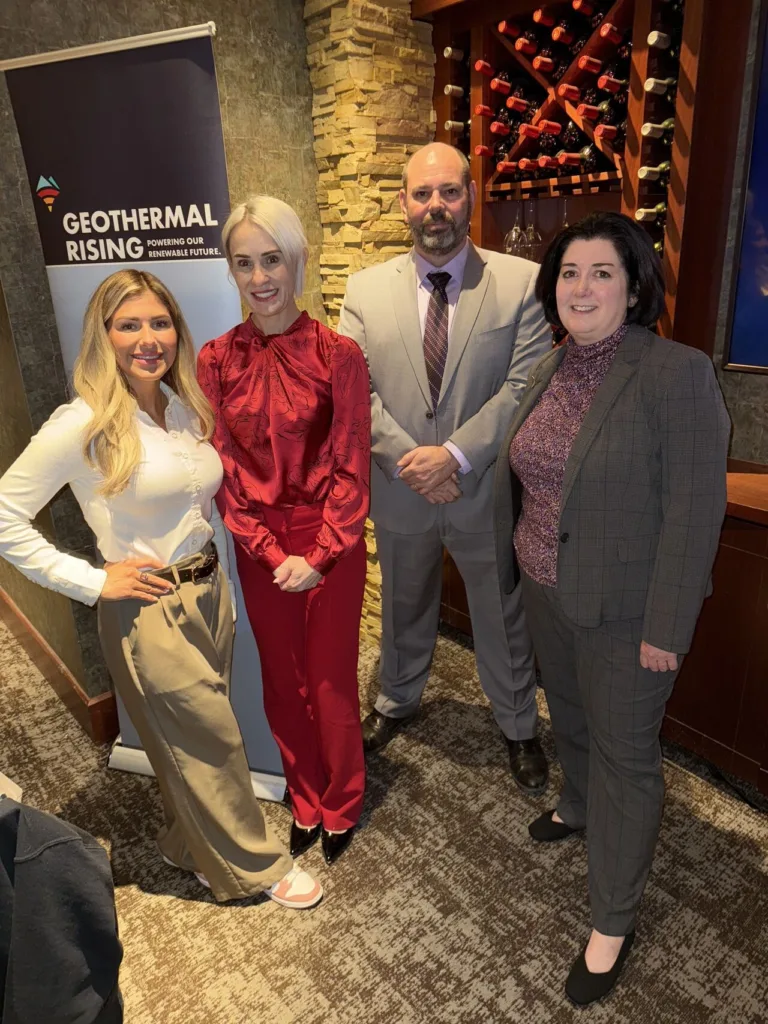
At a recent Geothermal Rising TXLAOK Regional Interest Group luncheon in Houston, Ignis shared how we think about geothermal development differently — not as venture technology, but as infrastructure built on disciplined subsurface risk reduction. One of the most persistent misunderstandings in geothermal is the belief that scale alone reduces risk. In reality, subsurface uncertainty does not decline with deployment. You cannot grow your way out of geological risk. At Ignis, we focus first on productive geothermal systems — where heat, permeability, and fluids converge — and we confront uncertainty early, with data, not optimism.
Our approach is structured around a clear Journey to Final Investment Decision (FID), where risk moves predictably as projects mature. Early phases are capital-light but data-intensive, emphasizing basin-scale screening, geophysics, and targeted exploration drilling to bound uncertainty before major capital is committed. Financeability is not an outcome — it is engineered through converging evidence: validated flow paths, sufficient heat, repeatable development concepts, and realistic commercial framing. As certainty rises, the cost of capital falls, enabling capital rotation and earlier exits rather than forcing investors to wait until construction or operation.
Crucially, Ignis develops geothermal as a portfolio, not as isolated single-asset bets. Portfolios distribute geological risk, allow learning to compound across projects, and keep progress moving even when individual assets pause or fail. This model enables multiple independent exit points, aligns capital with risk at every stage, and transforms uncertain subsurface opportunities into financeable infrastructure. From Alaska to Nevada, Turkey, Italy, and beyond, Ignis is proving that geothermal can scale — not by ignoring risk, but by measuring it, managing it, and designing development pathways that investors can trust.
