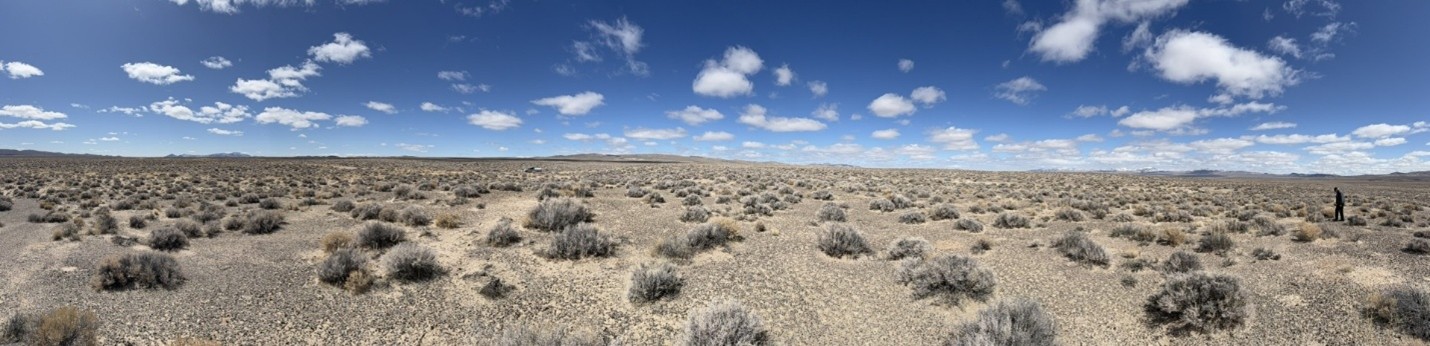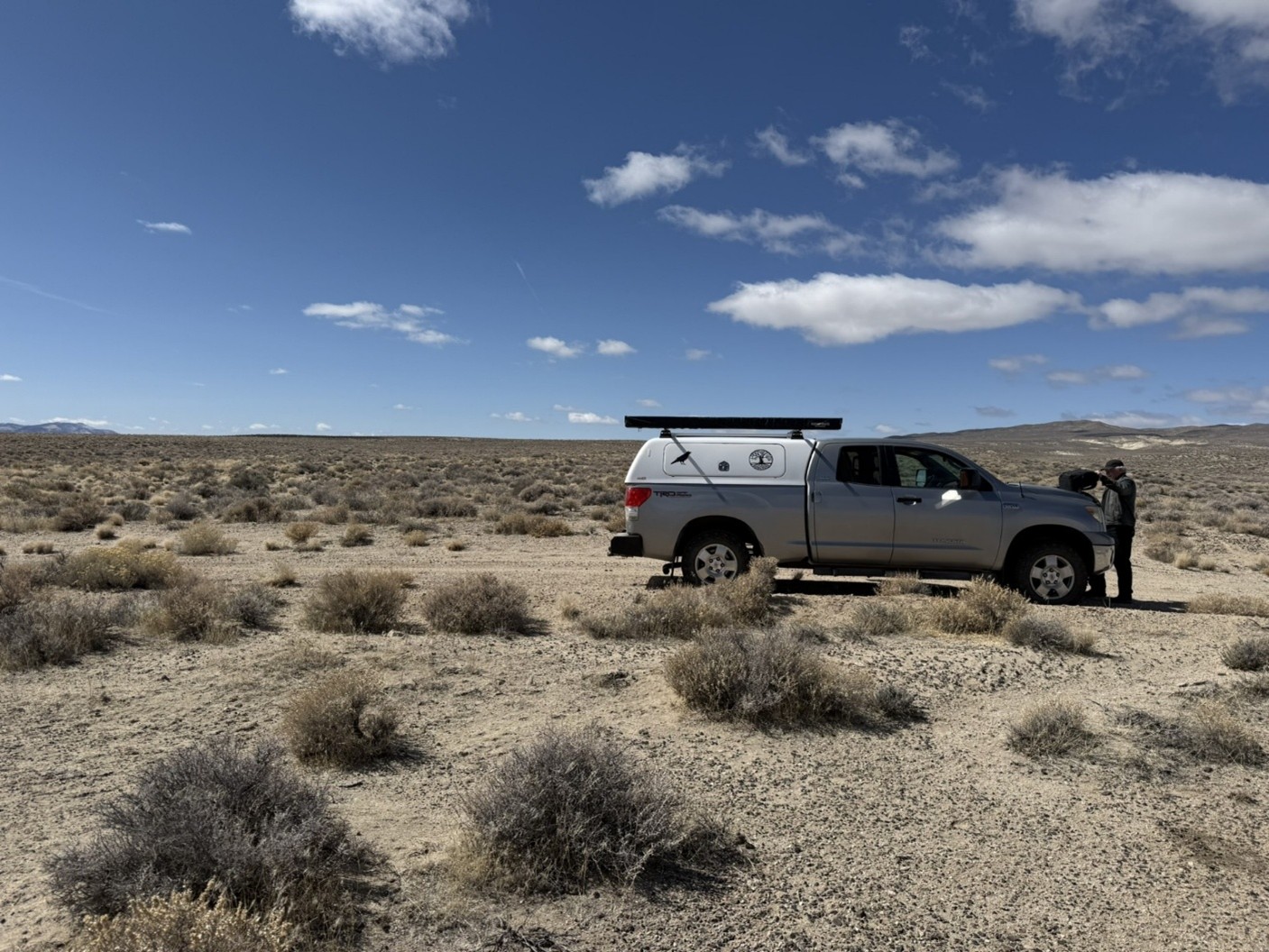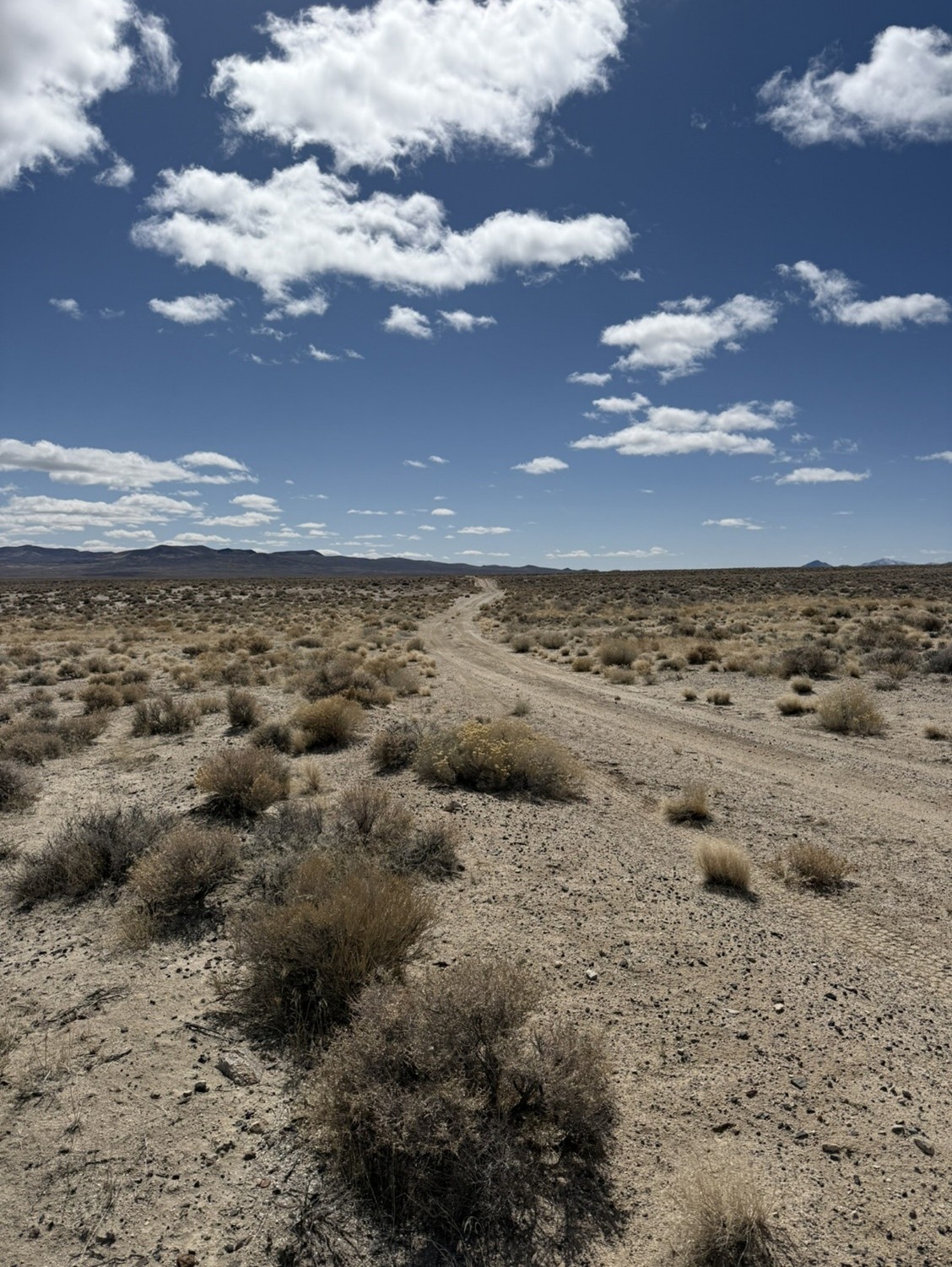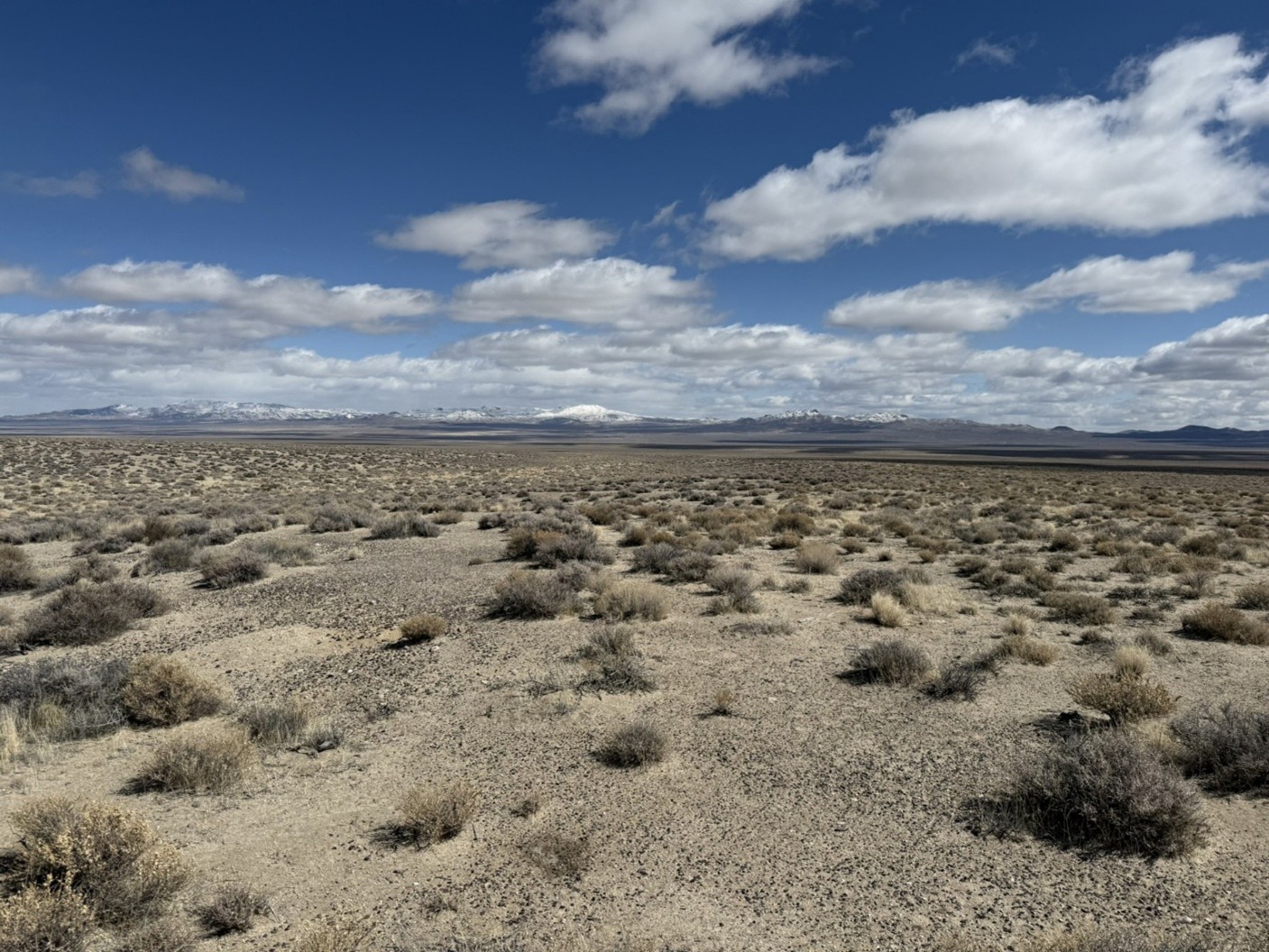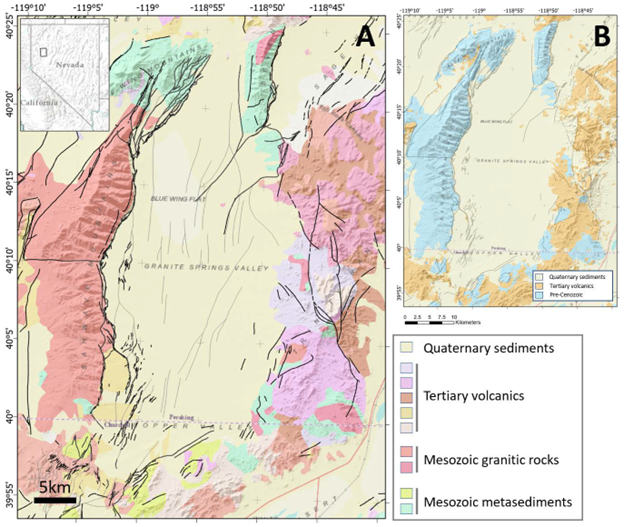
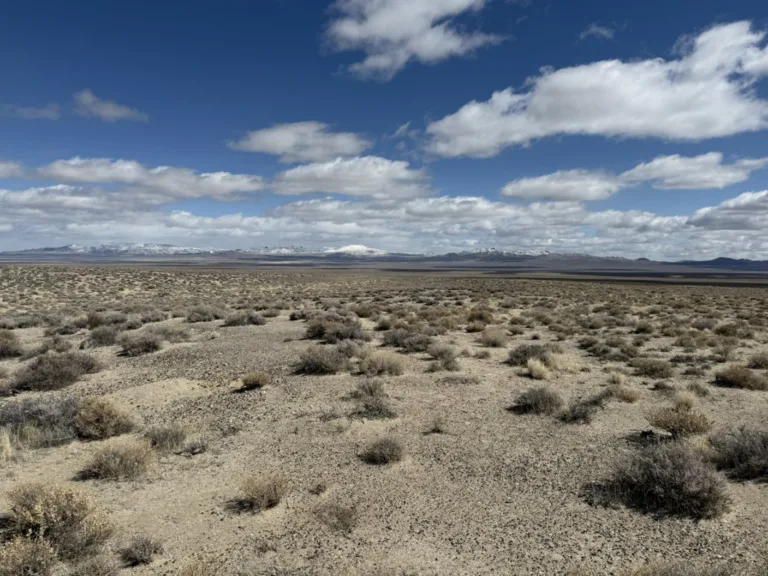
The Black Mountain geothermal prospect is located in Pershing and Churchill Counties in northern Nevada, within a region of broad valleys and mountain ranges known as the Basin and Range. The prospect lies at the southern end of Granite Springs Valley, flanked by the Sahwave Mountains to the west and the Trinity Range to the east. These surrounding mountains consist of older igneous and volcanic rocks, while the valley itself is filled with younger sediments and volcanic layers on top of ancient basement rocks. This geological setting is similar to nearby known geothermal areas like Bradys Hot Springs and Desert Peak just to the south. A major north-south fault along the western edge of the valley (the Sahwave range-front fault) has dropped the valley floor down relative to the mountains, creating a deep basin structure. Such faulting and extension of the crust provide pathways for heat from deep underground to rise closer to the surface, which is a favorable scenario for geothermal activity.
Geothermal exploration at Black Mountain dates to the early 1980s, when Phillips Petroleum Company drilled numerous shallow temperature survey wells and a few slim exploration wells in and around the prospect area. These wells were typically a few hundred feet deep (with the deepest slim wells reaching about 1,000–1,800 feet). The results showed that parts of the area have abnormally high heat flow. Many shallow holes recorded elevated temperature gradients – essentially the rate at which the ground warms up with depth was several times higher than the Nevada state average. This means the subsurface temperature increases very rapidly with depth, a strong indication of an underlying heat source. For example, one slim well (around 1,800 feet deep in the Adobe Flat area) measured temperatures that leveled off around 190 °F (88 °C) at just a few hundred feet down. Another well test encountered about 200 °F (96 °C) at roughly 1,100 feet depth, along with signs of hydrothermal alteration (minerals changed by hot fluids) in the volcanic rocks it penetrated. These wells likely did not drill deep enough to find the hottest part of the system. In addition to the drilling, geologists have found surface clues of past geothermal activity: for instance, deposits of silica sinter and travertine were identified east of the Black Mountain lease area, suggesting that natural hot spring fluids as hot as ~180 °C (356 °F) once flowed there.
Using industry-standard volumetric techniques, the team calculated the amount of heat in the subsurface to assess how much power the field might generate if developed. The results are promising: even the most conservative scenario indicated enough recoverable heat to support a commercial-scale power plant over a typical project lifespan. The mid-range estimate was substantially higher, suggesting Black Mountain could potentially produce a significant amount of renewable electricity if the resource is fully realized. GeothermEX has estimated the electrical-generation capacity of the leasehold to have P50 and P90 of 124 and 42 megawatts for 20 years, respectively. Nevertheless, the assessment highlights Black Mountain as a strong geothermal prospect with a substantial heat resource in place, comparable in scale to other developed geothermal fields in Nevada.
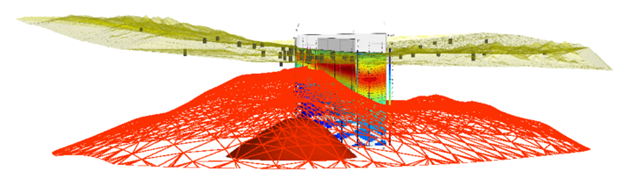
To build on these findings, additional exploration work has been underway to better understand the subsurface at Black Mountain. A Magnetotelluric (MT) survey was acquired by Ignis Energy early 2025 to aid in geothermal exploration and characterization. 67 MT stations were recorded, inverted and interpreted. Conductive layer, indicative of possible smectite alteration (“clay cap”) are seen in the data. In addition, shallow thermal gradient (TG) boreholes of high temperature gradients (100C+/KM) exist on the lease and correlate with the MT anomalies. A preliminary environmental assessment was completed in late 2022 and establishes a foundation for additional exploration activities.